
Links
about
The contrast between city and countryside is common in Lithuanian literature, but now, as if, texts by landless people are being revived. In Lithuanian literature, we call landless authors who worked in exile and who experienced a strong longing for their homeland, or rather, a longing for Lithuania. Many of them emigrated to live in big cities, leaving behind a quiet rural life in Lithuania. And above all, this work was inspired by the work of Jonas Mekas and his play “The Beginning of the Beginning”.
J. Mekas reflected on the themes of exile, identity, nostalgia and adaptation in a foreign culture in many of his works. Inspired by J. Mekas means that we are inspired by his personal experiences, the feeling of exile and loneliness, longing for his homeland, the search for identity, the fragility of time and other existential questions that arise for a person who finds himself at the crossroads of historical turning points, in a war-torn world that resonates with today's world. Inspired by J. Mekas' play "The Very Beginning of the Beginning" and his ability to focus human gaze on the here and now pulsating living nature, which exists without any human effort, without the effort of his mind.
Also, using texts by other Lithuanians living abroad that have already become classics – Antanas Škėma’s “Balta drobulė”, Alfons Nykas-Niliūnas’ “Eldorado” or Kazys Bradūnas’ “Donelaičio kapas” – we respond to today’s man, whom we have called “Homo asfaltus”. These creators are classified as landless in literature, because they all created in exile, usually in large cities around the world. And we transfer this feeling – longing for their homeland – to today’s Homo asfaltus, who in a global world feels like an exile and is searching for himself.
Homo asphaltus rides Bolt back and forth, just like Garšva (A.Škėma's "Drobulė") going up and down in an elevator, having completely lost all sense of meaning.
Homo asphaltus lives in the throes of the end of the world, due to the ongoing war, and yet can only care for wilted begonias.
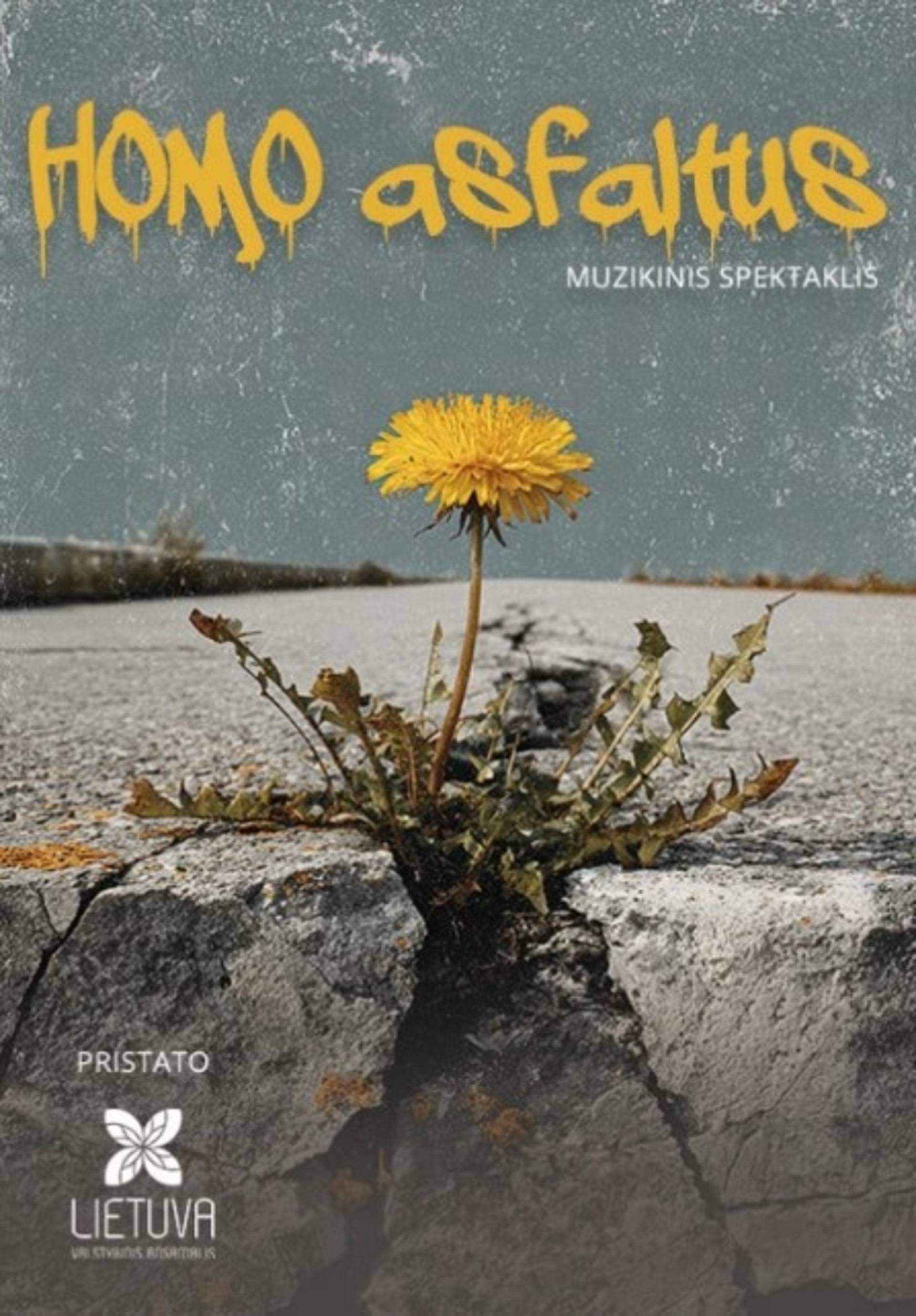
Homo asfaltus lives having lost the sense of home, of his land, doubting whether there is still land under the asphalt?
"The sense of the end of the world we live in is today an opportunity for the beginning of a new world. We have overestimated reason, so we are constantly spinning in the circles of hell, but there are still constructs that return us to nature, one of which is pregnancy," says director Giedrė Kriaučionytė-Vosylienė.
The libretto created by Laura Švedaitė tells the story of a woman who now lives in the city and is standing on a bridge, determined to dance, who learns from those around her that she is pregnant, because she herself does not notice this. First of all, this event turns her gaze to the world – “what kind of world will I release my future child into”? And her world is the city in which she lives – an allegory of hell – it is unbearably hot, wandering through it you spin in circles of anger, greed, and lies. The city is ruled by homeless people. People who have no home, just finding a place to sleep for another night. A pregnant woman – a city dweller – begins to feel the desire to return to nature, because as long as she is in the city, she is as if exiled from her normal state – life in nature. In the city, she meets an old man who is standing barefoot. He asks: “Am I the last generation who will walk barefoot”? She starts running and finds herself in the forest. Here she takes off her shoes and begins to feel nature speaking to her. Finally, labor begins and the rain pours down. A new person marks a new possible beginning and a new stage.
The music created by Dominykas Digimas reflects a journey from the rhythms heard in the present, which try to make Homo asfaltus feel. Modern music, devoid of subtlety, which must sound loud and intense in order to wake Homo asfaltus from stasis, as if to wake him from a dream of insensibility. It also reflects a journey through the national heritage - the sound of sutartines, kanklės, birbynias, music that Homo asfaltus knows but has forgotten, which evokes memories. A journey to the wordless plane of music, the archaic, where only sound remains and words disappear, where only feelings and the hope of a New Beginning function.